Thursday, October 13, 2016

THank you Park Cafe & Coffee Bar

Please show some love to our wonderful neighbors and supporters, Park Cafe & Coffee Bar. Thank you!!


The Julio-Claudian dynasty

During the play, Romulus names many of the chickens he raises – focusing almost more on his poultry than keeping the empire of Rome up and running – after emperors of the Julio-Claudian dynasty, he himself though as Rome’s last emperor, ruled long after the dynasty’s existence. This dynasty refers in particular to the first five emperors of Rome – Augustus, Tiberius, Caligula, Claudius, and Nero – who ruled from the second half of the 1st Century (44/31/27 BC), when the Empire was formed, until AD 68, when Nero committed suicide. A father-to-son style succession of leaders is notably absent amongst the five emperors of the Julio-Claudian dynasty. Tiberius and Claudius are the only amongst the five to have fathered sons both natural and legitimate. Tiberius’s son, Drusus, died prior to him; Claudius was the only one of the five emperors to die before his son. Even though Britannicus, his son, outlived him, he opted to promote Nero to the throne using the same method of selecting a successor to the throne that most of the emperors of the dynasty utilized: adoption.


Tuesday, October 11, 2016

Friedrich Durrenmatt

Born in Konolfingen, Switzerland, Friedrich Durrenmatt's father was a minister in the Protestant church and his grandfather had a low-key role in Swiss politics and also was well known for satire. Durrenmatt, began his studies in Bern and Zurich twenty years after his birth, focusing intently on literature and philosophy – he used justice as a tool in his writing taking it to an epistemological extreme. His first few plays all exhibit the same theme: the Church displaying weakness when faced with serious moral questions. A famed quote of Durrenmatt’s was, “As a Protestant, I protest;” he must therefore, have been very pleased with the fights and protests that exploded in the audience on the opening night of his first play in April, 1947. Romulus The Great, on which Romulus was based, was his first major success. In his play, Romulus hates Rome and is the only one able to see the true state in which Rome finds itself, one of degradation and corruption (hence the barnyard like nature of the court the audience sees at the beginning of the play and Pyramus and Achilles continual assertion that the Roman Empire is eternal and incapable of collapse). The calm sense of justice that give Romulus his heroism is seen in many of Durrenmatt’s main characters and can be considered one of the tools at the forefront of his arsenal. An interesting quality of his writing is how firmly he was opposed to the use of symbolism: “Misunderstandings creep in, because people desperately search the hen yard of my drama for the egg of explanation which I steadfastly refuse to lay.” Critics claimed that Vidal made frivolous Durrenmatt’s dark and majestic dramatic interpretation of the dangers of the Cold War so he felt forced to include in his 1966 hardcover publication of Romulus a translation of the original play of Durrenmatt’s from which he adapted his work.


Thursday, October 6, 2016

Thank You Park Avenue Pharmacy!

Another wonderful Bolton Hill business that we love and appreciate: Park Avenue Pharmacy! Professional service with a personal touch. Thank you for your continued support.

Olivia Steinrock (Set)

We are so lucky to have Olivia Steinrock on the Romulus Crew! She has been involved onstage in Memorial's productions of Mame, Sound of Music, Annie, and Oliver. Olivia spends her time scrapbooking and running her own pet sitting business in Bolton Hill.

So who was Romulus, the Last Emperor of Rome?

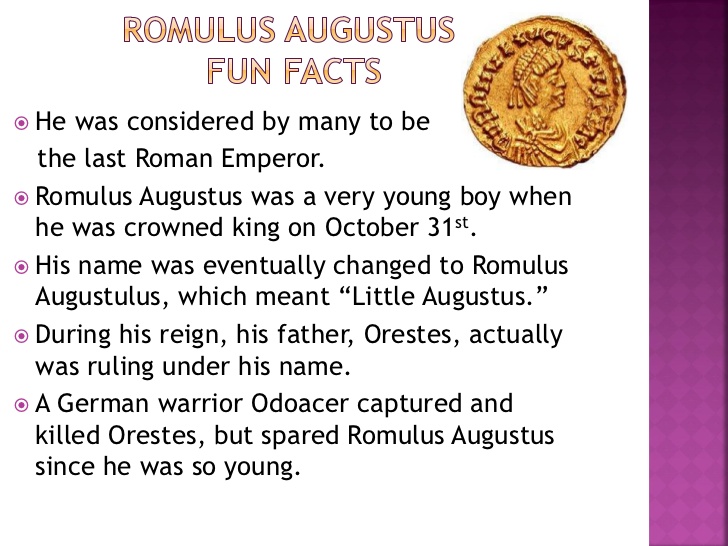
So who was Romulus, the Last Emperor of Rome? Well ... he was the son of Orestes, who once had been an assistant of Attila the Hun’s. Following Attila’s death, Orestes entered the service of the Western portion of the Roman Empire and rose the ranks quickly, soon finding himself in a senior position and eventually emperor. Romulus, much like in the play itself, has historically – even in his own day -- been the subject of a good deal of ridicule and mockery. His name alone invited insults, as Romulus was also the name of Rome’s first king (a legend in his own day) and Augustus was the famed first emperor of the Roman Empire. A mere ten months following Romulus’ promotion to emperor, a serious mutiny of the troops arose, primarily a result of the dislike of Romulus that existed among the German troops (Orestes was half German and he led the army to being mostly German). One of Orestes own senior officers, Flavius Odoacer (Ottaker in the play), led the protest as is seen in the play.


Tuesday, October 4, 2016

Titus! (Ryan Frank)

Don't miss Ryan Frank as Titus! Ryan is making his first appearance with Memorial Players. This is his second play after a decade-long break from acting due to law school and rural employment. When not onstage, he is an attorney for the US Department of Veterans Affairs. In their spare time, he and his wife foster cats and greyhounds and travel as often as they can back to Minneapolis to see friends and attend science fiction conventions.


Thank you, Belle Hardware!

Memorial Players couldn't do what we LOVE doing without the generous sponsorship of some local businesses. Thank you, Belle Hardware!


Monday, October 3, 2016

A quick read through of Act I yesterday afternoon

A quick read through of Act I yesterday afternoon
Nancy Kelso (Pyramus)

Kim Scaglione (Apollonia)

John Dignam, Mark Herbkersman and John Lisch

Ned Pollard (Theodoricus)

John Lisch (Metellus)

John Dignam (Otto Rumpf)

John Seeley (Narrator)

Kate Leisner (Assistant Director)

Terry O'Hara (Romulus)
 
Sean Dynan (Aemilian)

Saturday, October 1, 2016

Information about the Romulus Pre-Show Receptions


Consider attending one of the fabulous Pre-Show receptions, held in several of Bolton Hill’s beautiful Victorian residences before each show.  You will be wined and dined, after which you will be escorted to your VIP seats in the front of the theater. All proceeds go towards supporting Memorial Players. Tickets can be ordered online or by calling Paul Seaton at 410-615-4532.


Friday November 11 from 5:30 to 7 pm (show starts at 7:30 pm)

Home of Jonathan Claiborne and Debbie Diehl, 1410 Bolton Street. Co-hosted by Nicole Mitchell. --
Tickets: $40 / person.

Saturday November 12 from 5:30 to 7 pm (show starts at 7:30 pm)
Home of Michael Booth & Kristine Smets, 1308 Bolton Street.  Co-host: Ben and Stephen Skeritt-Davis. -- Tickets: $40 / person

Sunday November 13 from 1:30 to 3 pm (show starts at 3:30 pm)
Home of Connie and John Lisch, 1417 Eutaw Place. -- Tickets: $25 / person

Friday November 18 from 5:30 to 7 pm (show starts at 7:30 pm)
Home of Matt & Laura McNabney, 1420 Bolton Street. Co-hosted by Suzanne Brockman. -- Tickets: $40 / person

Saturday November 19 from 5:30 to 7 pm (show starts at 7:30 pm)
Home of Ron Gray & Maria Wawer, 1310 John Street. -- Tickets: $40 / person

Sunday November 20 from 1:30 to 3 pm (show starts at 3:30 pm)
Sponsored by Rev. Grey Maggiano, Memorial Episcopal Church, Upper Parish Hall. -- Tickets: $25 / person
 

Additional Ways to Support Memorial Players
The Theater Arts Committee of Memorial Episcopal Church welcomes all donations, no matter how small.  Please send a check to “Memorial Episcopal Church,” write “Memorial Players” in the memo line, and mail to
Memorial Players
c/o Memorial Episcopal Church
1409 Bolton Street
Baltimore, MD  21217